
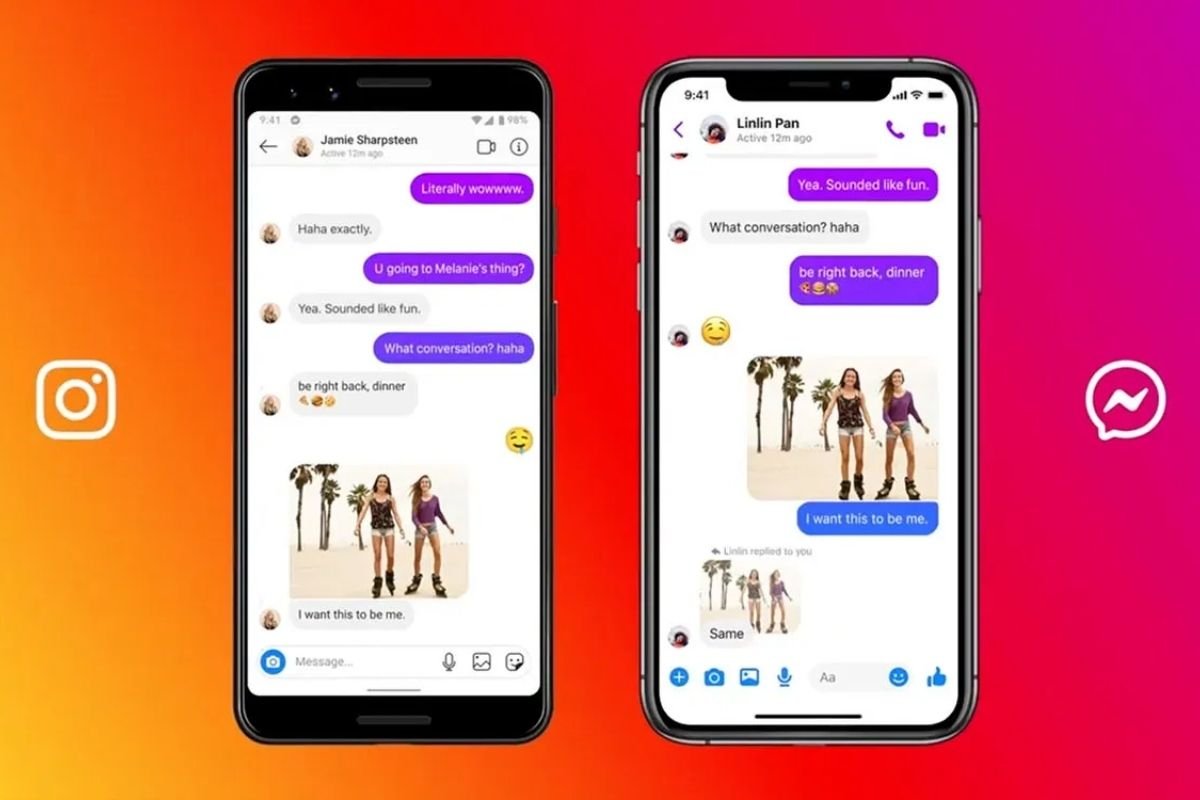
The screenshot landed in my inbox at 7:18 a.m., the hour when people forward things before they’ve had coffee and while their judgment is still loading. A neat Instagram DM exchange, cropped tight, two profile circles at the top and a stack of messages below. The tone was familiar: flirty, then sharp, then cruel. It ended with the kind of line that travels well, a tidy little grenade meant for reposts.
“Is this real?” the sender asked.
By 9:00, the same image was everywhere, pasted into Stories with reaction stickers, stitched into TikToks with a robotic voice reading it aloud, argued over in comment sections where strangers spoke with the certainty of jurors. It had the usual ingredients: a recognizable name, a moral hook, just enough specificity to feel intimate. If it was fake, it was a good fake.
And it took less than an hour to find out how it could have been made.
The screenshot economy
A DM screenshot is a strange kind of currency. It buys attention fast because it feels like contraband. Unlike a polished apology video or a press statement, a chat log suggests you’re seeing the truth before it’s sanitized. Even people who swear they hate “internet drama” will lean in.
The problem is that chat screenshots now sit at the intersection of two trends: our willingness to treat images as receipts, and the growing ease of manufacturing those receipts.
Anyone who’s spent time in fandom spaces has seen it up close. A screenshot appears alleging a creator is rude to fans. Another shows a brand rep making an offhand joke that reads as offensive when removed from context. Someone “leaks” a private conversation from a group chat. The alleged speaker denies it, then people argue about fonts and timestamp spacing like they’re analyzing a moon landing photo.
It’s not that fabricated messages are new. People have been faking emails since email existed. What’s changed is the friction. The tools are clean, the interfaces look familiar, and you don’t need to know anything about Photoshop.
A tool with a drop-down menu
When I looked at the image that morning, I wasn’t searching for a smoking gun. I was searching for convenience. If the screenshot was fake, how quickly could an ordinary person make something like it?
The answer is uncomfortably quickly.
Sites like fake instagram chat offer a menu of platforms, then a set of fields: names, avatars, message bubbles, timestamps, read receipts. You can build an exchange the way you’d build a slide deck, line by line, adjusting the little details that make it feel authentic. WhatsApp, Discord, iMessage, Telegram, Messenger, X, Slack, Signal, TikTok, Snapchat, LINE, Microsoft Teams, even dating apps and OnlyFans. The variety matters because drama isn’t loyal to one platform. It goes wherever the audience is.
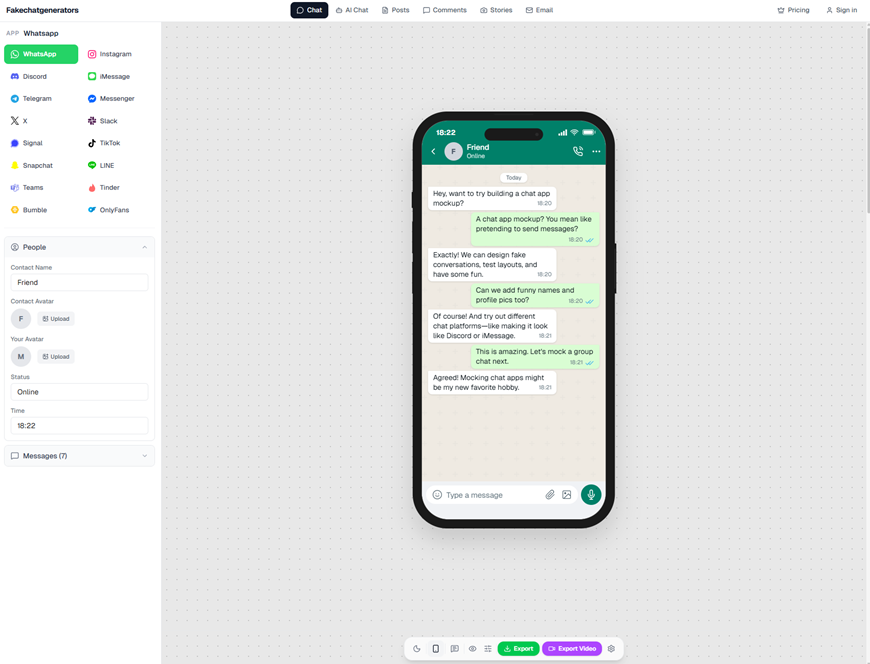
fakechatgenerators.com lets you mock up chat screenshots across 16 platforms
The site isn’t marketed as a weapon. It’s marketed as a tool. Memes, pranks, film and TV mockups, UX wireframes, content marketing, classroom examples, storyboarding. All plausible, all real. A director might need a chat sequence for a scene without exposing a real person’s messages. A teacher might want to demonstrate online harassment without using real slurs from a real case. A social media creator might script a skit. There are benign reasons.
But in the attention economy, intent is slippery. The same convenience that helps a production assistant build a prop can help someone frame a rival.
How the “real” look is engineered
The most convincing fakes don’t rely on technical wizardry. They rely on social realism.
They get the cadence right. Short bursts, then a pause. A typo that feels human. A “lol” that lands wrong, which is often the point. They include one message that reads like it came from a specific person, the verbal quirk or catchphrase fans will recognize. They know where to stop the screenshot, right before context would complicate the story.
Often, the image is technically perfect because the generator is technically perfect. The alignment is consistent. The typography matches current UI. The margins are clean. That perfection, ironically, can be a tell. Real screenshots are messy. They have battery icons, notification banners, a thumb shadow, a weird crop because someone was rushing. The best fakers add mess back in on purpose.
And then comes distribution, the part that makes any fabrication feel inevitable. The screenshot is posted by an account that seems adjacent to the subject, not too close, not too random. It’s framed as a reluctant share. “I didn’t want to post this, but people deserve to know.” That line, or some variation of it, is the internet’s version of “I hate to say it, but…”
Once the screenshot moves, it’s no longer just an image. It’s a test of allegiance. Believe it and you’re on the “right side.” Question it and you’re accused of defending the villain. This is how misinformation hardens: not through evidence, but through identity.
The verification gap
When I asked a colleague in media forensics how they approach viral chat images, they described the first pass as “boring questions.” Who posted it first? Is there a longer version? Are there multiple screenshots that overlap? Does the UI match the time period? Are there anomalies in compression, cropping, or re-saves that suggest the image has been edited?
None of that is satisfying for people watching the drama unfold in real time. The feed wants a verdict, not a process.
There’s also a subtle trap: viewers assume that because something looks like a screenshot, it must have originated on a phone. But an image is just pixels. It can be a photo of a screen, a screen capture, a render, or a reconstruction. The “screenshot” label is a vibe, not proof.
This is where detection tools enter the conversation, especially as synthetic media becomes more common. Some platforms and newsrooms use scanners that look for signs of AI generation or tampering, and they do it at scale because humans can’t manually vet every image that comes in.
One service, ai image detection, positions itself for exactly that pipeline, flagging AI-generated media, NSFW content, violence, and document tampering. It claims 98.7% detection accuracy across more than 50 generative models, including Midjourney, DALL-E, Stable Diffusion, Flux, Ideogram, Google Gemini, and GANs, with sub-150ms latency. Those numbers are attractive for journalists on deadline, trust and safety teams triaging reports, or marketplaces trying to stop fraud before it spreads.
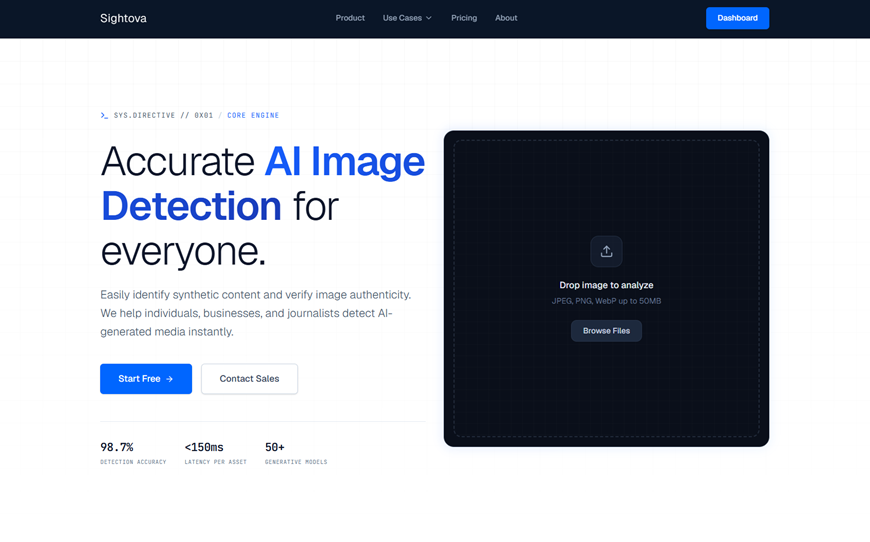
sightova.com flags AI-generated, tampered, NSFW, and violent imagery in milliseconds
But a tool like that is not a magic stamp of truth. It’s one lens. Fake chat screenshots made through a generator aren’t necessarily “AI images.” They can be perfectly human-made. And even when an image is flagged, that doesn’t automatically answer the story question: who made it, why, and what happened next?
A case study in how it spreads
Back to the screenshot from my inbox. As it ricocheted through social media, three camps formed within hours.
The first camp treated it as definitive, a receipt so damning that no further context could matter. They posted it with captions like “I always knew.” The screenshot served as permission to air older grievances, and soon the chat was less important than the pile-on it enabled.
The second camp dismissed it immediately, not because they had proof, but because they disliked the story. They counter-posted with their own screenshots, sometimes real, sometimes not, to argue the opposite narrative. Drama doesn’t always seek truth. Sometimes it seeks symmetry.
The third camp did the slow thing: they asked for more. They questioned the crop. They asked why the time stamps were missing. They noted that the account shown in the header used an old profile picture. They didn’t go viral for it.
By afternoon, a longer version appeared, allegedly the “full conversation.” It included a few extra lines of setup that softened the person who had looked worst in the original. The implication was clear: someone had cropped the first image to maximize outrage. That second image changed minds for some people, and for others it was simply proof that the accused had time to fabricate a defense.
At that point, truth was almost beside the point. The screenshot had already done its work. Sponsors were tagged. Employers were contacted. A rumor doesn’t need to be accurate to be effective. It just needs to be plausible long enough to cause damage.
What to look for when you’re being handed “receipts”
If you’re a regular person staring at a chat screenshot in your feed, you probably don’t have time to do forensic analysis. Still, you can do a quick reality check before you repost.
- Ask what’s missing. Crops are editorial decisions. What’s above and below the frame? Is there a reason you aren’t seeing the header, the time, the account handle, the date?
- Notice the “too perfect” problem. If the screenshot looks like a marketing render, it might be. Real screenshots often carry little scuffs: notification bars, inconsistent cropping, accidental blur.
- Look for a second source that isn’t just a repost. Ten accounts sharing the same image is still one source.
- Separate “this could happen” from “this did happen.” Plausibility is not verification, it’s just a feeling.
Most importantly, consider the social cost of being wrong. Reposting a fake chat isn’t a neutral act. It’s an accusation with a megaphone.
The quiet aftermath
A day after the screenshot landed, the story had already started to slide down the feed, replaced by the next outrage. That’s usually how it ends for spectators.
For the people in the screenshot, real or not, the timeline is different. They live in the residue: the DMs from strangers, the screenshots saved to other people’s phones, the search results, the awkward conversations at work. Even if a fabrication is exposed, the correction rarely travels as far as the initial hit. The internet is better at ignition than cleanup.
The uncomfortable truth is that we’ve built a culture where private conversations are treated as public evidence, and we’ve also built tools that can manufacture that evidence with a few clicks. The gap between “I saw it” and “it happened” is wider than it looks on a small screen.
The next time a DM screenshot tries to recruit you, asking you to pick a side, pause long enough to ask a dull question: how hard would it be to fake this? The answer, increasingly, is that it wouldn’t be hard at all.

I’m Rosie, the creator of CookWithRosie, where I share my favourite recipes that excite everyday cooking. I love experimenting with flavours and creating dishes that are easy, tasty, and fun for everyone to try at home.